
The World
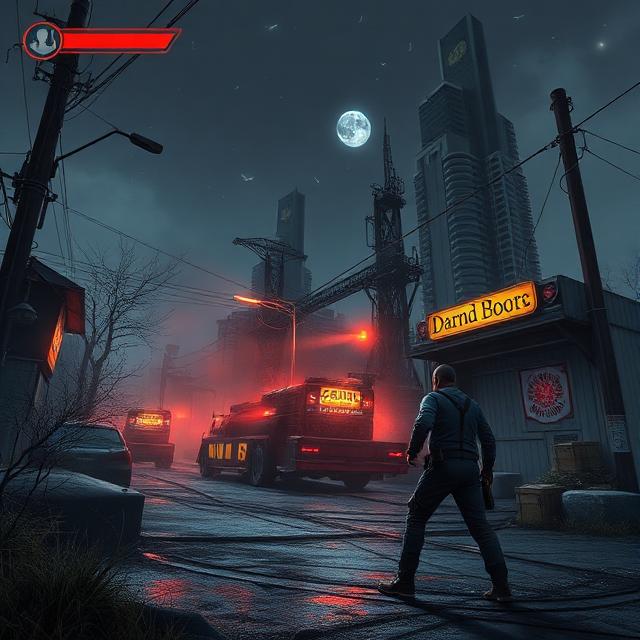
Vesper Drive takes place over a single night that never ends, in a city Midnight Cartel calls Lumen — a sprawl of wet asphalt, sodium glare and rain that falls at a precise forty-five degrees because someone on the art team decided it looked better that way. It does. This is a racer with a screenplay, and the screenplay is a chase: you are a getaway driver working off a debt you did not choose, and every district you unlock is another act in a story told entirely at speed.
What sets Lumen apart from the usual neon backdrop is that it is legible at two hundred kilometres an hour. The art direction does the hardest thing a racing game can do — it stays readable while drowning in style. Brake lights tell you where traffic is folding before you can see it. The colour of a district's neon tells you whose territory you are in. You learn to read the city the way a courier reads a route, and by the final act you are navigating on instinct through streets you have never driven, because Lumen teaches you its grammar without ever stopping to explain it.

The Systems
There is no lap counter. Vesper Drive measures you in escapes. Each chapter is a pursuit — sometimes you are chased, sometimes chasing — and the handling model is built around nerve rather than the perfect racing line. The signature mechanic is the Vesper drift: a long, committed slide that builds a meter you can spend on a burst of impossible grip, but only if you hold the slide past the point where instinct screams to correct. The game is constantly daring you to stay sideways one beat longer than feels safe, and rewards the brave with the exact gap they needed.
It is the only racer in years where I held my breath, and the only one that earned it.
Damage is narrative, not numeric. Clip a pillar and you do not lose health; you lose a mirror, then a door, then the handling character of the car itself, until the machine you finish a chase in feels meaningfully wounded. Midnight Cartel resists upgrades-as-spreadsheet entirely. You do not tune Vesper Drive for marginal gains; you choose a car for its temperament and learn to forgive its flaws, the way you would a partner. It is a deeply unusual progression philosophy for the genre, and it gives the whole thing the weight of consequence.
Art & Sound
The audio is the best work Midnight Cartel has ever shipped. The soundtrack — a live synthwave score that reacts to your drift meter — swells as you commit and drops to a held breath when you spin out, so the music is effectively a second tachometer you feel rather than read. Engine notes are sampled from real machines and then bent slightly out of true, giving every car a voice you can identify with your eyes shut.
Visually it is all contrast and restraint: deep blacks, surgical neon, and rain that catches every light source in the scene. The interface is nearly invisible, trusting the world to carry the information. There is one indulgence — a slow-motion crash cam that triggers on the worst wrecks — and even that earns its keep by making failure feel cinematic rather than punitive.

Performance
Speed games live or die on frame consistency, and Vesper Drive is rock-solid where it counts — the pursuit sequences held an unwavering frame rate on our reference hardware even with the full rain and reflection stack enabled. The reflection system, which renders the wet city twice over, is the obvious cost, and dropping it one notch on mid-range machines buys a comfortable margin with almost no visual loss.
Our only real complaint is loading between chapters, which lingers a few seconds longer than the genre's best. Given that the rest of the package is so tightly tuned, the wait stands out. We saw no crashes across the campaign and two full replays.